Essential Oils for Arthritis: Best Oils, Massage Blends, and What Research Says
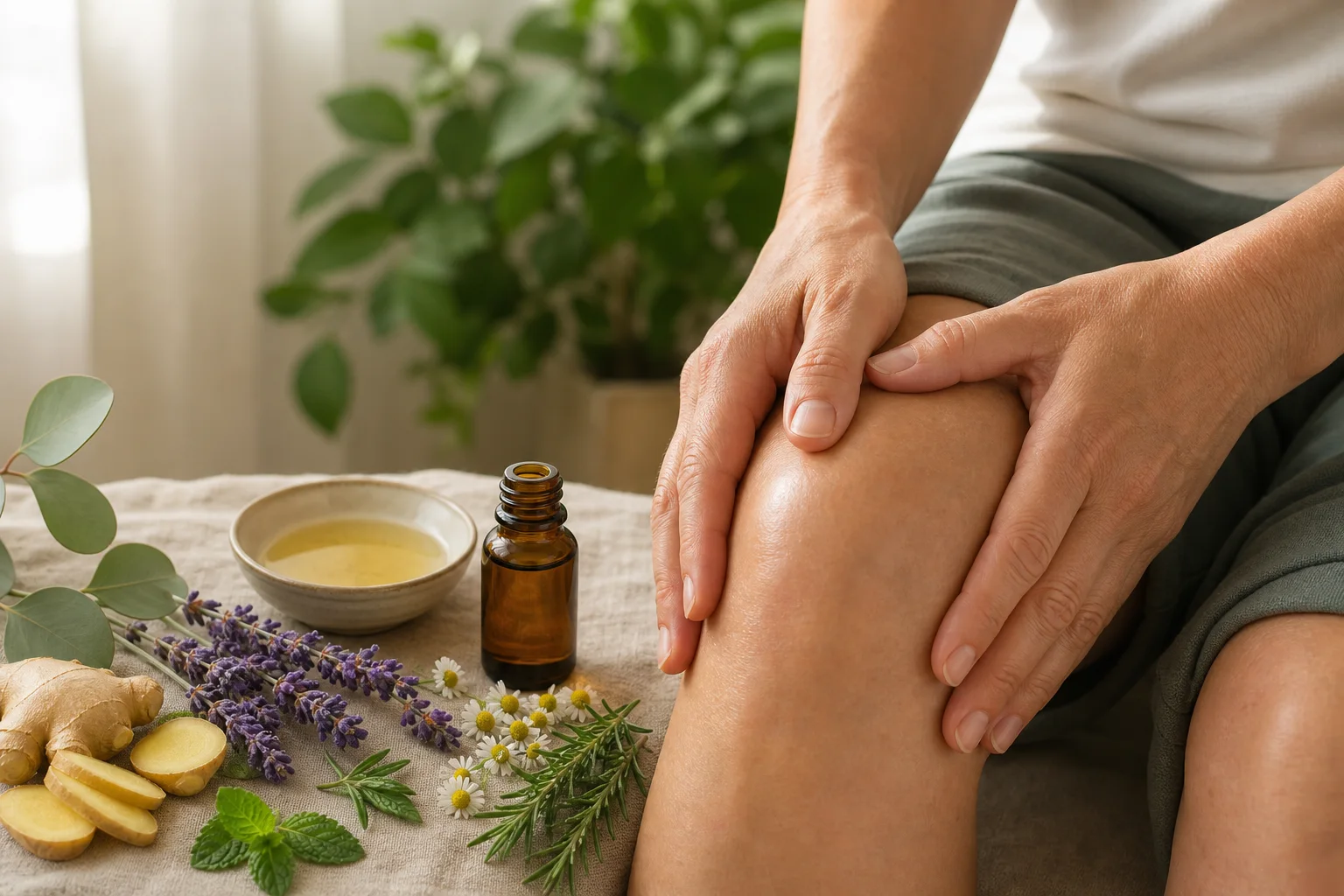
Essential oils can be a genuinely pleasant part of an arthritis comfort routine. Ginger and black pepper bring warming aroma, peppermint and eucalyptus feel cooling, lavender and chamomile make massage more relaxing, and sweet marjoram is a favorite for stiffness. Used in a well-diluted massage oil, they may help an achy joint feel more comfortable for a while.
That is the useful promise—and the honest limit. Essential oils do not rebuild cartilage, remove uric-acid crystals, or control the immune activity behind rheumatoid or psoriatic arthritis. Human studies suggest that topical aromatherapy can provide short-term, add-on relief for pain, but the research is small and varied. Keep prescribed treatment, movement, physical therapy, and medical follow-up at the center of the plan; let aroma and gentle massage make that plan feel better.
Quick answer: the best essential oils for arthritis comfort
For a simple adult joint-massage blend, these are the oils most worth considering:
- Lavender: The best-researched single essential oil for aromatherapy massage in knee osteoarthritis, with a soft aroma suited to regular use.
- Ginger: A warming favorite with one small trial of ginger-and-orange massage for short-term knee-pain relief.
- Peppermint: Menthol-rich and cooling; especially useful when a fresh sensation feels better than warmth.
- Eucalyptus: A penetrating, refreshing partner for peppermint in daytime massage blends.
- Sweet marjoram: A traditional aromatherapy choice for stiffness and tight muscles around an achy joint.
- Roman or German chamomile: Gentle-smelling companions for lavender and evening massage.
- Black pepper: Warming and spicy; use sparingly in a low-dilution blend.
Frankincense, copaiba, rosemary, helichrysum, turmeric, and plai also appear frequently in online arthritis blends. They can be enjoyable additions, but their arthritis reputations rely more heavily on traditional use, laboratory research, related extracts, or general aromatherapy experience than on strong human trials of the essential oils themselves.
Arthritis is not one condition
“Arthritis” means joint inflammation, but it covers more than 100 conditions. The right medical treatment depends on the type.
- Osteoarthritis involves changes throughout a joint, including cartilage, bone, and surrounding tissues. Pain often develops gradually, worsens with use, and comes with relatively brief stiffness after rest.
- Rheumatoid arthritis is an autoimmune disease. It often affects matching joints on both sides of the body and can cause prolonged morning stiffness, swelling, fatigue, and problems beyond the joints.
- Psoriatic arthritis can occur with psoriasis and may affect joints, tendons, the spine, fingers, or toes.
- Gout causes sudden attacks when urate crystals trigger intense inflammation, often in one joint.
- Septic arthritis is an infection inside a joint and needs urgent treatment.
The National Institute of Arthritis and Musculoskeletal and Skin Diseases emphasizes getting the type diagnosed so the proper treatment can begin. An oil that makes massage more soothing does not identify the cause of joint pain.
What essential-oil websites recommend
Across aromatherapy retailers and reference sites, the recommendations are remarkably consistent. Plant Therapy’s guide to joint discomfort highlights ginger, frankincense, eucalyptus, copaiba, lavender, turmeric, and a warming commercial blend. AromaWeb’s arthritis guide lists black pepper, copaiba, frankincense, German and Roman chamomile, ginger, lavender, marjoram, and plai. Edens Garden expands the list with clove, juniper, peppermint, spruce, thyme, citrus, and ylang ylang.
Commercial joint products often use a similar sensory strategy:
- Cooling oils and constituents: peppermint, eucalyptus, wintergreen, camphor
- Warming oils: ginger, black pepper, clove, cassia
- Softening, relaxing aromas: lavender, chamomile, marjoram
- Resinous or earthy oils: frankincense, copaiba, helichrysum, spruce
Those lists are useful for understanding what aromatherapy users actually choose. They are not all equally supported by clinical evidence, and some of the strongest-feeling oils are also the easiest to misuse. A beginner does not need wintergreen, birch, cassia, or a high concentration to make a satisfying joint blend.
What the research actually says
The overall picture is cautiously positive. A 2023 systematic review and meta-analysis combined eight randomized trials of topical essential oils for musculoskeletal conditions, including knee and hand osteoarthritis and rheumatoid arthritis. The authors found a modest improvement in pain versus placebo immediately after treatment and a smaller effect at four weeks. They described essential oils as an add-on treatment, not a replacement for medical care.
There are important reasons not to oversell that result. The trials used different oils, carrier oils, massage methods, diagnoses, treatment schedules, and pain scales. Aromatic products are also difficult to blind: people can often smell which treatment they received. Massage, caring attention, expectation, and the carrier oil may contribute to the experience.
A 2021 systematic review of essential-oil therapy in rheumatic diseases found only 13 studies. Lavender was used most often, followed by ginger and rosemary. The results were promising, but “few reports” is the key limitation. We still need larger, better-controlled trials that identify the oil, botanical species, chemistry, dilution, dose, and long-term safety.
Lavender has the clearest arthritis-specific trial
In a randomized trial of 90 people with knee osteoarthritis, lavender-oil massage was compared with almond-oil massage and no massage. Pain was lower immediately after the intervention and at one week, but there was no significant difference between groups at four weeks.
That makes lavender a sensible first choice for short-term comfort. It does not prove that lavender changes the joint itself or slows osteoarthritis. The benefit also came from an aromatherapy massage protocol, not from an undiluted drop placed on a knee.
Ginger and orange massage showed short-term potential
A double-blind trial in 59 older adults with moderate-to-severe knee pain studied six massages over three weeks using 1% ginger and 0.5% sweet orange essential oils. Pain and physical function improved more at the one-week assessment, but the differences were not sustained at four weeks and quality of life did not significantly change.
This is a good reason to enjoy ginger as a warming massage oil. It is not evidence that ginger essential oil treats the underlying arthritis. Also, research on culinary ginger extracts should not automatically be applied to steam-distilled ginger essential oil; they are chemically different preparations.
Peppermint and eucalyptus mainly offer a sensory effect
Peppermint’s menthol activates cold-sensitive receptors in the skin, creating a cooling feeling. Eucalyptus contributes a fresh, penetrating aroma and is commonly paired with it. That sensory shift may temporarily make a sore area feel different or easier to ignore.
Human research has examined eucalyptus inhalation after knee-replacement surgery, but that setting is not the same as rubbing eucalyptus on an arthritic joint. For arthritis, think of peppermint and eucalyptus as practical comfort oils with a plausible sensory role—not proven anti-arthritis treatments.
Frankincense essential oil is not the same as Boswellia extract
Frankincense belongs in a joint blend if you enjoy its resinous, grounding aroma. But many online claims blur an important distinction. Human arthritis research on Boswellia usually studies oral resin extracts standardized for boswellic acids. A typical steam-distilled frankincense essential oil is a volatile aromatic product and should not be assumed to deliver the same compounds or effects.
The Tisserand Institute’s review of frankincense chemistry explains why boswellic acids generally do not appear in analyses of ordinary frankincense essential oils. Frankincense oil may still make a beautiful massage blend; the evidence for a Boswellia supplement cannot be used as proof that the essential oil treats arthritis.
Four practical adult massage blends
These recipes use about a 2% dilution: 12 total drops of essential oil in 30 mL (1 fluid ounce) of carrier oil. Drop sizes vary, so the percentage is approximate. Jojoba, fractionated coconut oil, grapeseed oil, or an unscented lotion base can work.
Choose one blend, not all four at once. Patch-test it on a small area of healthy skin and wait 24 hours before broader use.
1. Gentle daily joint blend
- 5 drops lavender essential oil
- 3 drops ginger essential oil
- 2 drops sweet marjoram essential oil
- 2 drops Roman chamomile essential oil
- 30 mL carrier oil
This is the best all-purpose starting formula: softly warming, relaxing, and not aggressively minty. Massage a small amount around an achy knee, hand, shoulder, or foot for a few minutes. Use light, comfortable pressure.
2. Cooling daytime blend
- 5 drops lavender essential oil
- 3 drops peppermint essential oil
- 2 drops eucalyptus radiata essential oil
- 2 drops sweet marjoram essential oil
- 30 mL carrier oil
Use this when a cool, fresh feeling is more welcome than warmth. Wash your hands after applying it and keep it far from eyes, face, mucous membranes, and damaged skin. Do not place a heating pad over a strong minty rub; altered temperature sensation can make it harder to judge heat.
3. Warming ginger-and-pepper blend
- 6 drops ginger essential oil
- 2 drops black pepper essential oil
- 4 drops lavender essential oil
- 30 mL carrier oil
Black pepper goes a long way. This blend is designed to feel gently warm, not hot or burning. Stop immediately if the skin stings, becomes very red, or feels increasingly irritated. A warm compress can be pleasant, but test the temperature carefully and avoid it during an acutely hot, swollen flare.
4. Calming evening blend
- 6 drops lavender essential oil
- 3 drops Roman chamomile essential oil
- 3 drops sweet marjoram essential oil
- 30 mL carrier oil
This softer blend is useful when joint discomfort and frustration make it hard to settle down. Apply it during a short hand, foot, shoulder, or knee massage, then pair it with the gentle range-of-motion routine recommended by your clinician.
For a more conservative 1% dilution, use 6 total essential-oil drops per 30 mL of carrier. A lower dilution is a smart choice for older adults, sensitive skin, frequent use, or anyone new to topical oils.
How to massage an arthritic joint
Massage should feel nurturing, never punishing.
- Check the skin and joint first. Do not massage over broken skin, rash, infection, unexplained bruising, marked heat, or sudden swelling.
- Warm a teaspoon of the diluted blend between clean palms.
- Begin with broad, slow strokes around—not forcefully into—the painful area.
- Use gentle circles on the muscles above and below the joint. Avoid hard pressure over bony points.
- Continue for 3 to 5 minutes, stopping if pain increases.
- Wash your hands, especially before touching eyes, inserting contact lenses, or handling food.
Massage may be inappropriate after a fresh injury, around a possible blood clot, over a joint replacement with new symptoms, or during a hot inflammatory flare. A physical therapist or massage therapist familiar with arthritis can adapt pressure and positioning.
Heat, cold, and oils
The NIAMS osteoarthritis guide notes that both heat and cold can reduce pain for some people. Heat may improve flexibility and comfort; cold can temporarily numb an achy area and may help during a swollen flare.
Use temperature safely:
- Wrap a cold pack rather than placing it directly on skin.
- Keep heat comfortably warm, not hot, and check the skin often.
- Avoid heat or cold if sensation or circulation is impaired unless a clinician has advised it.
- Do not combine a heating pad with a menthol-, camphor-, or methyl-salicylate-heavy rub.
- Do not use warmth on a newly hot, red, swollen joint before the cause is known.
An essential-oil massage blend can be used at a different time from the hot or cold pack. More sensation is not necessarily more relief.
Why wintergreen and birch need special caution
Wintergreen and sweet birch smell familiar because methyl salicylate is used in many commercial muscle-and-joint rubs. In a regulated finished product, the concentration, directions, and warnings are part of the formula. A bottle of wintergreen essential oil is a much more concentrated ingredient.
Swallowing even a small amount can cause serious salicylate poisoning. The risk is especially concerning for children and also matters for people with aspirin sensitivity, bleeding disorders, anticoagulant use, kidney problems, pregnancy, or upcoming surgery. A poison-control consensus guideline treats more than a taste of wintergreen oil in a young child as potentially toxic.
For home arthritis blends, skip wintergreen and birch. Also be cautious with camphor, cassia, cinnamon bark, clove, oregano, and thyme thymol. Their intense warmth or cooling does not make them better choices for routine use, and several can irritate or sensitize skin.
If anyone swallows an essential oil, do not induce vomiting. In the United States, contact Poison Control at 1-800-222-1222 or Poison.org; call emergency services for severe symptoms.
Essential-oil safety for arthritis
People with arthritis often use medications or have other health conditions, so a little extra planning matters.
- Dilute every topical oil. Start at 1% to 2%; stronger is not automatically better.
- Patch-test first. Stop for burning, hives, swelling, blistering, or a worsening rash.
- Use only on intact skin. Avoid wounds, rashes, injection sites, surgical incisions, and infected areas.
- Do not ingest the oils. Routine internal use is unnecessary for these recipes and introduces different dose, interaction, and toxicity concerns.
- Review medications and diagnoses. Ask a pharmacist or clinician before regular use if you take anticoagulants, have aspirin allergy, seizure disorders, asthma triggered by fragrance, kidney or liver disease, or use multiple topical medicines.
- Keep topical products separate. Do not layer an essential-oil blend over a prescription cream, topical NSAID, lidocaine, capsaicin, or medicated rub unless a pharmacist says the combination is appropriate.
- Use extra caution in pregnancy, breastfeeding, childhood, and frail older age. Generic adult recipes are not automatically suitable.
- Protect children and pets. Store oils and finished blends locked away, with clear labels and child-resistant caps when possible.
- Replace oxidized oils. Old citrus, conifer, tea tree, and lavender oils can be more likely to irritate skin. Keep bottles cool, dark, tightly closed, and dated.
Read the site’s broader safe-use guide before making topical blends.
When joint pain needs medical attention
Do not assume new joint pain is “just arthritis.” Seek urgent medical evaluation for:
- A sudden, severely painful, hot, swollen, or discolored joint, especially with fever, chills, or feeling unwell
- Inability to bear weight, a deformed joint, numbness, or severe pain after a fall or injury
- A painful or swollen joint near a recent operation, injection, wound, bite, or artificial joint
- New weakness, loss of bladder or bowel control, or numbness around the groin with back or joint symptoms
The NHS septic-arthritis guidance describes sudden severe pain and swelling—often in one joint—as needing prompt assessment because infection can damage a joint quickly.
Arrange a routine appointment if pain or swelling keeps returning, affects sleep or normal activity, lasts more than a couple of weeks, or comes with morning stiffness lasting more than 30 minutes. Symmetrical swelling in hands or feet, psoriasis with joint symptoms, unexplained fatigue, fever, or weight loss also deserves evaluation.
If you have rheumatoid arthritis, essential oils should never replace disease-modifying treatment. NIAMS notes that joint damage can begin in the first one or two years and that early treatment is important. A comforting hand massage can accompany a rheumatology plan; it cannot do the job of a DMARD.
The habits that make the biggest long-term difference
Essential oils are most useful when they help you participate in care that protects function.
- Keep moving. Range-of-motion, strengthening, walking, cycling, swimming, tai chi, and water exercise can reduce osteoarthritis pain and stiffness when matched to your abilities.
- Work with physical or occupational therapy. A professional can teach joint-friendly movement, pacing, hand protection, and use of braces or assistive tools.
- Use prescribed medicine as directed. Ask about side effects or alternatives rather than stopping an arthritis medicine on your own.
- Pace activity without becoming completely inactive. Alternate demanding tasks with recovery and change repetitive movements.
- Support sleep and stress management. Lavender or chamomile aroma may be especially helpful here, even when the joint effect is subtle.
- Discuss weight without shame. For someone with osteoarthritis in weight-bearing joints, gradual weight management may reduce joint stress, but it is only one part of a broader plan.
If a pleasant massage blend makes it easier to stretch, sleep, take a walk, or feel cared for on a difficult day, it is doing useful work.
Bottom line
Lavender and ginger have the most directly relevant human research for essential-oil massage and knee pain, while peppermint, eucalyptus, sweet marjoram, chamomile, and black pepper make practical cooling, warming, or relaxing partners. The evidence supports temporary comfort as an add-on, not an arthritis cure.
Start with a 1% to 2% dilution, patch-test, massage gently, and choose oils for the sensory experience you enjoy. Skip risky DIY wintergreen and high-intensity blends. Most importantly, know which type of arthritis you have and keep treatments that protect the joint and control the disease in place.
Sources and further reading
- Bakó E, et al. Efficacy of Topical Essential Oils in Musculoskeletal Disorders: Systematic Review and Meta-Analysis of Randomized Controlled Trials. Pharmaceuticals. 2023.
- Paixão VLB, de Carvalho JF. Essential oil therapy in rheumatic diseases: A systematic review. Complementary Therapies in Clinical Practice. 2021.
- Nasiri A, Mahmodi MA, Nobakht Z. Effect of aromatherapy massage with lavender essential oil on pain in patients with osteoarthritis of the knee. Complementary Therapies in Clinical Practice. 2016.
- Yip YB, Tam ACY. Massage with aromatic ginger and orange essential oil for moderate-to-severe knee pain among older adults. Complementary Therapies in Medicine. 2008.
- National Institute of Arthritis and Musculoskeletal and Skin Diseases. Osteoarthritis and arthritis overview.
- American College of Rheumatology. 2019 guideline for osteoarthritis of the hand, hip, and knee.
Last reviewed: August 1, 2026
Medical disclaimer: This article is for education and general wellness information. It does not diagnose arthritis or replace individualized care from a physician, rheumatologist, pharmacist, physical therapist, or other qualified professional. Essential oils may cause irritation, allergy, toxicity, or medication-related concerns. Seek urgent care for a sudden hot, swollen joint, fever with joint pain, a serious injury, or rapidly worsening symptoms.
<!– ARTICLE END –>