Essential Oil First Aid Kit: 5 Useful Oils and Safe Ways to Use Them
A small essential oil first aid kit is absolutely worth having. Lavender can bring calm when a minor mishap rattles everyone, peppermint is a refreshing favorite for head tension and queasiness, ginger fits naturally in a travel kit, and tea tree and Roman chamomile are versatile choices for everyday skin-comfort blends.
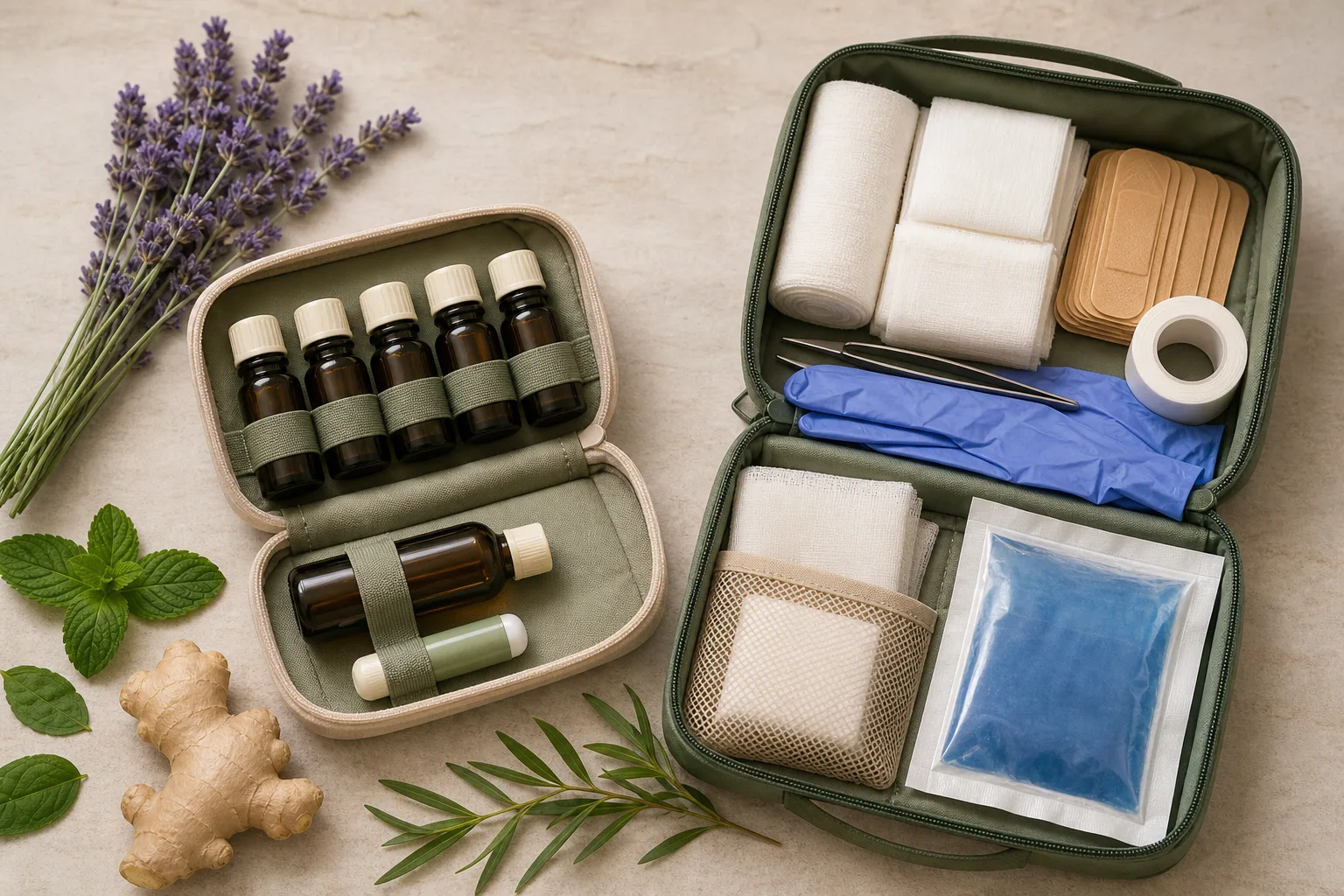
The best kit gives these oils the right role. Essential oils are excellent companions for comfort, aroma, and a few carefully diluted uses on unbroken skin. Sterile gauze, clean water, bandages, a cold pack, prescribed emergency medicine, and first-aid knowledge still do the actual first-aid work. Think of the oils as a botanical comfort pouch that sits beside—not instead of—a well-stocked medical kit.
Quick answer: the five best oils for a simple kit
If you want a compact, useful collection, start here:
- Lavender: The best all-around choice for a calming inhaler and gentle, diluted skin-comfort blend.
- Tea tree: The classic cleansing oil for formulated skin products; best used diluted on intact skin, not as a wound disinfectant.
- Peppermint: Cooling and invigorating for an adult tension roller or personal inhaler; keep it away from eyes and young children’s faces.
- Ginger: A warm, spicy aroma that belongs in every travel kit for occasional queasiness.
- Roman chamomile: A soft, comforting partner for lavender in calming and sensitive-skin blends.
For an expanded kit, add helichrysum for its long-standing aromatherapy reputation in bruise and skin-care blends, or frankincense for grounding aroma and massage. These are lovely upgrades, but the five-oil core covers more situations for less money.
Start with a real first aid kit
An essential-oil pouch becomes much more useful when it lives beside supplies that can clean, cover, cool, and protect. The American Red Cross first-aid kit checklist includes adhesive bandages, sterile gauze, tape, nonlatex gloves, an instant cold compress, tweezers, an emergency blanket, personal medications, emergency phone numbers, and first-aid instructions.
At minimum, keep these basics at home and in your travel kit:
- Sterile gauze pads and assorted adhesive bandages
- Medical tape and a roller bandage
- Nonlatex gloves
- Tweezers and small scissors
- An instant cold pack
- Plain petroleum jelly in a tube
- Any personal emergency medications prescribed for your household
- A written medication and allergy list
- Emergency numbers, including Poison Control in the United States: 1-800-222-1222
- Current first-aid instructions or a reputable first-aid app
Check the kit twice a year. Replace used supplies, expired products, dried-out wipes, leaking rollers, oxidized oils, and anything with a label you can no longer read.
Why these oils keep showing up in aromatherapy kits
There is a striking amount of agreement across established essential-oil websites. Plant Therapy’s natural medicine cabinet highlights eucalyptus, tea tree, lavender, blue tansy, frankincense, lemon, and peppermint or spearmint, then specifically recommends pre-diluted lavender, tea tree, and peppermint roll-ons. Young Living’s first-aid list includes lavender, marjoram, peppermint, spearmint, bergamot, and chamomile among its versatile home choices. doTERRA’s introductory kit centers on lavender, lemon, and peppermint. AromaWeb likewise describes lavender as a first-aid-kit staple.
That overlap is helpful. It tells us which oils experienced formulators and everyday users repeatedly reach for: lavender for calm and skin comfort, mint for cooling freshness, tea tree for cleansing formulations, chamomile for soothing, and citrus for bright aroma.
This article takes the most useful part of those recommendations—the oils and the practical formats—while leaving out routine ingestion, undiluted application, homemade water sprays without a proper dispersant, and essential oils directly on cuts or burns. Those limits do not make an oil less valuable. They make the kit easier to use confidently.
1. Lavender: the first bottle to pack
Lavender essential oil earns the first slot because it can support both the emotional and physical sides of a small mishap. Its familiar floral-herbal aroma is a natural fit when someone feels startled, tense, or unable to settle. A systematic review of randomized trials found that lavender aromatherapy may reduce anxiety, although study methods varied and stronger research is still welcome.
Lavender also has an interesting research backdrop in wound care. A 2020 review found potential benefits in laboratory, animal, and some human studies, but the authors called for standardized products and better human trials. That is encouraging science for future formulations—not a reason to drip lavender into an open cut at home.
Best kit uses:
- Add lavender to a personal inhaler for a comforting aroma after the immediate first-aid steps are handled.
- Use a properly diluted lavender roller on wrists, shoulders, or other unbroken skin when tension rises.
- Blend lavender with Roman chamomile in an adult skin-comfort oil for intact, mildly irritated skin away from the actual wound.
- Add it to a post-activity massage blend; the site’s muscle-cramp guide has practical formulas and limits.
Lavender is gentle by essential-oil standards, but “gentle” still means diluted, labeled, and kept out of eyes and mouths.
2. Tea tree: the cleansing specialist
Tea tree is the bottle many aromatherapy enthusiasts associate with cleansing. Its fresh, medicinal aroma and broad laboratory antimicrobial activity explain why it appears in blemish products, foot-care formulas, scalp products, and commercial skin cleansers.
A 2023 systematic review of randomized human trials found promising uses for several topical tea tree preparations, but overall study quality was poor to modest and adverse skin reactions were reported. The evidence supports respecting tea tree as a useful formulation ingredient; it does not prove that neat tea tree oil sterilizes a wound or prevents infection.
Best kit uses:
- Choose a reputable, pre-diluted tea tree roll-on for intact-skin spot use according to its label.
- Add tea tree to a low-dilution foot or shoe-care blend when traveling.
- Keep it as an ingredient for planned personal-care recipes rather than improvising during an injury.
Do not put tea tree oil into an open cut, puncture, animal bite, burn, eye, ear, nose, or mouth. For a minor cut, cool or lukewarm water and mild soap are better first steps.
3. Peppermint: cooling comfort for adults
Peppermint is the compact kit’s bright, energetic problem-solver. Its menthol-rich aroma feels cooling even though it does not actually lower body temperature. Many people reach for it during a tension headache, after a long drive, or when a wave of nausea makes travel unpleasant.
Clinical studies of peppermint preparations do not support every online claim, but there is a reasonable evidence trail for specific uses. Research has examined topical peppermint preparations for headache, and aromatherapy studies have explored peppermint-containing inhalers for nausea. Results depend on the exact concentration, route, and setting, so a home roller or inhaler should be presented as comfort—not guaranteed treatment.
Best kit uses:
- Carry an adult-only, pre-diluted peppermint roller for the back of the neck or shoulders, never close to the eyes.
- Use a personal inhaler for fresh aroma during mild travel queasiness.
- Pair one part peppermint with two or three parts lavender in an adult massage blend for tired muscles.
- See the site’s guides to tension headaches and motion sickness for more complete instructions and warning signs.
Peppermint is not the best default for babies or young children, anyone who reacts to menthol, or use near the face. Never use it in the eyes, nostrils, or on damaged skin. A strong cooling sensation is not proof that an injury is improving.
4. Ginger: the travel-kit favorite
Ginger essential oil brings a warm, spicy aroma that feels steadying when a car, boat, flight, or medical procedure leaves the stomach unsettled. It is especially practical in a personal inhaler because the oil never has to touch skin.
In a randomized postoperative study, ginger aromatherapy and a ginger-mint blend reduced reported nausea more than saline over a short observation period. Another randomized trial in people receiving chemotherapy found a short-term improvement after ginger inhalation but no convincing overall treatment effect. In other words, ginger aroma is a promising comfort tool, not a replacement for anti-nausea medicine or evaluation of persistent vomiting.
Best kit uses:
- Keep ginger in a clearly labeled personal inhaler for occasional mild queasiness.
- Blend ginger with a small amount of peppermint for an adult travel inhaler.
- Pair ginger with lavender when you want a softer, less mint-forward aroma.
Seek medical advice for repeated vomiting, dehydration, severe abdominal pain, vomiting blood, a severe headache, confusion, chest pain, or nausea after a head injury. Pregnancy, chemotherapy, and chronic illness deserve individualized guidance rather than a generic recipe.
5. Roman chamomile: soft, steady comfort
Roman chamomile essential oil has a sweet, apple-like aroma that blends beautifully with lavender. It is a good choice when the goal is comfort rather than stimulation: settling down after a scare, creating a restful atmosphere, or adding softness to a low-dilution skin blend.
Chamomile aromatherapy appears in emerging human research on anxiety and stress, but studies use different chamomile species and protocols. Its strongest reason for a place in this kit is practical aromatherapy experience: it is pleasant, versatile, and easy to pair with lavender.
Best kit uses:
- Combine Roman chamomile with lavender in a personal calming inhaler.
- Use it in a low-dilution adult roller for wrists or shoulders.
- Add one drop to a larger batch of unscented massage oil when a softer aroma is preferred.
People allergic to ragweed, daisies, chrysanthemums, or other plants in the Asteraceae family should use extra caution or choose another oil.
Optional upgrade: helichrysum for a botanical skin blend
Helichrysum, also called immortelle, is one of aromatherapy’s most prized skin-care oils. It is frequently included in blends for the appearance of bruised, stressed, or mature skin, and its warm honey-herbal aroma pairs well with lavender and frankincense.
Helichrysum is an optional luxury, not a first-aid necessity. Human evidence for treating bruises, stopping bleeding, or healing acute injuries is not strong enough to make those promises. If you enjoy it, use it at low dilution on intact skin after serious injury has been ruled out. Do not apply it to active bleeding or let it delay evaluation of unexplained or extensive bruising.
Build two pouches, not one mystery bag
Separating supplies makes the kit faster and safer to use.
Pouch 1: real first aid
- Gloves, gauze, bandages, tape, tweezers, scissors, cold pack, petroleum jelly, and instructions
- Prescribed emergency medications kept in their original packaging
- Medication, allergy, and emergency-contact information
Pouch 2: aromatic comfort
- Lavender, tea tree, peppermint, ginger, and Roman chamomile in small amber bottles
- One unscented carrier oil, such as jojoba, in a leak-resistant bottle
- Two or three pre-diluted, clearly labeled rollers
- One or two personal inhalers
- Small zip bags to isolate a leak
- A dilution card and the date each blend was made
Do not decant oils into unlabeled bottles. Write the common name, botanical name, dilution, carrier, intended user, and preparation date on every roller. Keep the pouch cool, dark, upright, and out of children’s and pets’ reach. A hot vehicle shortens an oil’s useful life, so bring a travel pouch inside rather than storing it in the glove compartment year-round.
Three simple preparations to make ahead
Prepared products are much easier to use well than loose bottles during a stressful moment.
Calm-and-reset personal inhaler
- 4 drops lavender essential oil
- 2 drops Roman chamomile essential oil
Add the oils to the cotton wick of a blank personal inhaler, insert the wick, cap it, and label it. Hold the inhaler a short distance below the nose and take one or two gentle breaths. Do not insert it into a nostril or share it between people. Stop if the aroma causes coughing, wheezing, headache, or nausea.
Adult travel-queasiness inhaler
- 4 drops ginger essential oil
- 2 drops peppermint essential oil
Prepare and label it the same way. Use it as an optional comfort measure while also getting fresh air, looking toward the horizon, sipping fluids when appropriate, or following a clinician’s travel-sickness plan. Do not use an aroma to push through severe or unexplained nausea.
Gentle adult comfort roller for intact skin
- 1 drop lavender essential oil
- 1 drop Roman chamomile essential oil
- Jojoba or fractionated coconut oil to fill a 10 mL roller bottle
This is approximately a 1% dilution, although drop size varies. Apply a small amount to wrists, forearms, shoulders, or another area of healthy skin. It is not a cut, burn, bite, or wound treatment. Patch-test before adding it to the kit, and never use a new blend for the first time during an emergency.
Buying a reputable pre-diluted roll-on is an equally good—and often more consistent—choice. Follow its label rather than adding extra drops to make it “stronger.”
What to do for common minor mishaps
Small cuts and scrapes
Wash your hands, apply pressure if needed, rinse the cut with cool or lukewarm water, and gently clean around it with mild soap. The American Academy of Dermatology’s minor-cut guidance recommends petroleum jelly and a sterile bandage, with daily bandage changes. It specifically advises against routine topical antibiotic ointment because it can irritate skin.
Keep essential oils out of the cut. If the person is shaken, a lavender inhaler can support calm while the wound receives standard care.
Get prompt medical care for bleeding that will not stop, a deep or gaping wound, loss of sensation or movement, embedded debris, an animal or human bite, a puncture, significant contamination, or signs of infection. Check whether tetanus vaccination is current.
Minor thermal burns
Put a minor burn under clean, cool running water promptly. The American Academy of Dermatology recommends cooling for about 10 minutes, then petroleum jelly and a nonstick sterile bandage for a small first-degree burn. Do not apply ice, butter, toothpaste, undiluted essential oil, or an oil-based roller to a fresh burn; oils can trap heat and irritated skin is more permeable.
Large, deep, blistering, electrical, chemical, facial, hand, foot, joint, or genital burns need professional assessment. Burns in infants, older adults, or medically vulnerable people also deserve a lower threshold for care.
Insect bites and stings
Wash the area, remove a visible bee stinger without squeezing the venom sac, and use a wrapped cold pack for local swelling. If the skin is intact and the reaction is clearly mild, a previously patch-tested lavender–chamomile roller can be used nearby for aromatic and skin comfort. Do not apply it to scratched-open skin.
Trouble breathing, swelling of the face or throat, widespread hives, faintness, vomiting, or rapidly worsening symptoms can signal anaphylaxis. Use prescribed epinephrine immediately according to the person’s emergency plan and call emergency services. Essential oils have no role in delaying that response.
Bruises, strains, and sore muscles
A cold pack, protection from further injury, and sensible rest come first. Once a fracture, severe sprain, or internal injury is not suspected, a low-dilution lavender massage oil can make the surrounding intact skin and muscles feel cared for. Helichrysum is a popular optional addition for aromatherapy enthusiasts.
Do not massage a visibly deformed limb, a rapidly swelling area, a possible blood clot, unexplained bruising, or an injury with numbness, weakness, or inability to bear weight.
Head tension and mild queasiness
This is where the aromatic pouch shines. Use a peppermint inhaler or a pre-diluted adult tension roller away from the eyes, or choose ginger inhalation for travel queasiness. Pair the oil with water, food, rest, fresh air, reduced screen strain, or the person’s usual care plan.
A sudden “worst headache,” headache after a head injury, weakness on one side, confusion, fainting, stiff neck with fever, chest pain, persistent vomiting, or severe dehydration needs urgent evaluation.
Essential oils that do not belong in a beginner first aid kit
More oils do not automatically make a better kit. These are poor grab-and-go choices for beginners:
- Wintergreen: Highly concentrated methyl salicylate can be dangerous when swallowed and may be inappropriate around children, people using anticoagulants, or anyone with aspirin sensitivity.
- Camphor-rich oils: Small swallowed amounts can cause serious poisoning, especially in children.
- Cinnamon bark, cassia, oregano, clove, and thyme thymol: These potent oils can irritate or sensitize skin and are too easy to misuse under stress.
- Phototoxic citrus oils: Expressed bergamot, lime, lemon, and some other citrus oils can increase sun sensitivity on skin. Keep them for intentional aromatic use or choose products with clear phototoxicity directions.
- Any unlabeled blend: If you cannot identify every ingredient and dilution, it does not belong in a first-aid pouch.
These oils can still have valuable places in skilled aromatherapy. A compact emergency-adjacent kit simply favors forgiving, clearly labeled choices.
Core safety rules
- Do not swallow essential oils or add them to water, tea, capsules, or food as home first aid.
- Do not apply essential oils to damaged skin, open wounds, fresh burns, eyes, ears, nostrils, or other mucous membranes.
- Dilute before skin use and follow oil-specific limits. The site’s Safe Use of Essential Oils guide explains dilution and patch testing.
- Keep bottles and inhalers locked away from children and pets. Child-resistant caps are helpful but are not childproof storage.
- Do not assume one dilution works for adults, children, pregnancy, breastfeeding, older adults, or people taking medication.
- Avoid shared inhalers. Stop aromatic use if it worsens asthma, migraine, nausea, or fragrance sensitivity.
- Never use oils near oxygen equipment, flames, or heat sources.
- Keep products in their original containers whenever possible so a poison specialist can identify them.
Poison Control advises dilution for skin use and says not to use essential oils on damaged skin. If someone swallows an essential oil in the United States, use webPOISONCONTROL or call 1-800-222-1222. Do not induce vomiting unless a poison specialist tells you to. For a rash, wash the remaining oil off with soap and water; breathing difficulty is a medical emergency.
What the research does—and does not—say
Essential oils bring together three different kinds of support:
- Aromatic comfort: Lavender and chamomile can make a stressful moment feel calmer, while peppermint and ginger can make a travel pouch feel fresher and more usable.
- Traditional and professional aromatherapy practice: Decades of formulators’ experience explain the repeated use of lavender, tea tree, mint, chamomile, and helichrysum in commercial products.
- Emerging scientific evidence: Human research suggests potential benefits for specific lavender, tea tree, peppermint, and ginger preparations, but results cannot be transferred automatically to every bottle, recipe, concentration, or injury.
Laboratory antimicrobial activity does not prove that an oil disinfects a cut in real life. A wound-healing study does not prove that a homemade roller is sterile. A cooling sensation does not reduce a sprain or fever. The science is most useful when it helps us choose realistic roles: aroma for calm or nausea, diluted products for intact skin, and standard first aid for tissue injury.
Bottom line
The ideal essential oil first aid kit is compact, prepared in advance, and refreshingly practical. Start with lavender, tea tree, peppermint, ginger, and Roman chamomile. Add helichrysum only if you love botanical skin-care blends and understand its evidence limits. Carry personal inhalers and low-dilution rollers instead of improvising with neat oils.
Most important, give the oils a strong partner: a real first-aid kit with clean dressings, gloves, a cold pack, emergency information, and current first-aid instructions. That combination preserves what essential oils do best—bring comfort, pleasant aroma, and a thoughtful ritual—without asking them to do the jobs of wound care, emergency medicine, or professional treatment.
Aromatherapy and formulation sources
- How to Create Your Own Natural Medicine Cabinet — Plant Therapy
- 9 Essential Oils for Your All-Natural First-Aid Kit — Young Living
- Introductory Kit: Lavender, Lemon, and Peppermint — doTERRA
- Lavender Essential Oil Profile — AromaWeb
- Essential Oil Dilution Guidelines — Tisserand Institute
Medical, safety, and research sources
- Make a First Aid Kit — American Red Cross
- How to Treat Minor Cuts — American Academy of Dermatology
- How to Treat a First-Degree Minor Burn — American Academy of Dermatology
- Essential Oils: Poisonous When Misused — Poison Control
- Aromatherapy — National Center for Complementary and Integrative Health
- Aromatherapy Product Claims and Regulation — U.S. Food and Drug Administration
- Lavender Essential Oil and Wound Healing: Review of Current Evidence — PubMed
- Lavender Aromatherapy for Anxiety: Systematic Review and Meta-Analysis — PubMed
- Tea Tree Oil for Human Health: Systematic Review of Randomized Trials — PubMed
- Aromatherapy for Postoperative Nausea: Randomized Trial — PubMed
- Inhaled Ginger Aromatherapy for Nausea: Randomized Trial — PubMed
This article is for education only. It describes essential oils as optional comfort tools and does not replace first-aid training, product labels, Poison Control, or medical care.
Last reviewed: August 1, 2026