Essential Oils for Bruises: Evidence, First Aid, and Safety
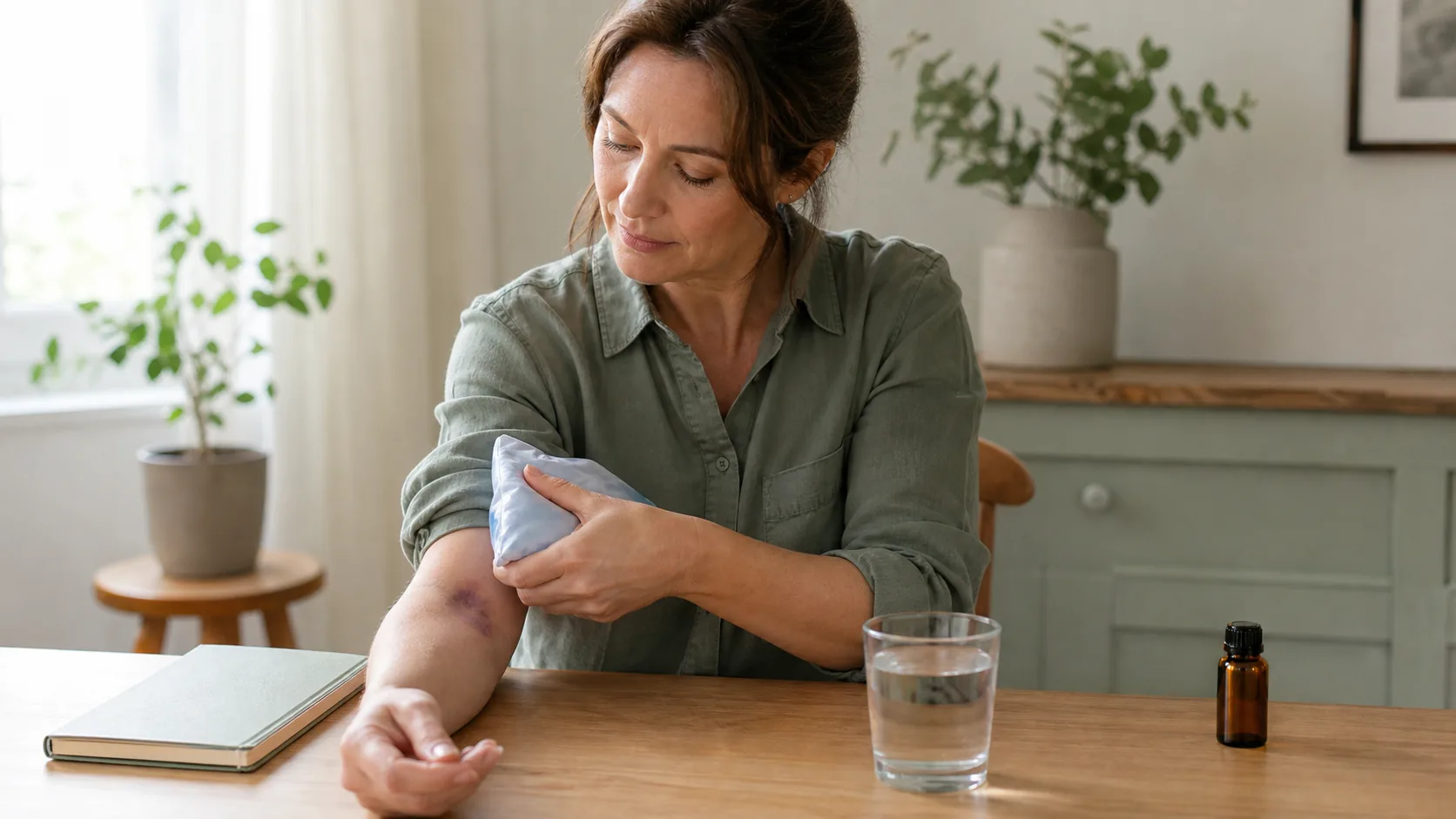
Most ordinary bruises heal on their own. A wrapped cold pack, rest, and elevation are better-supported early steps than essential oils. Helichrysum, lavender, cypress, and geranium appear in many aromatherapy bruise blends, but there is not good clinical evidence that applying these oils makes a routine bruise disappear faster.
If an adult still wants to use a scented oil on a small, clearly explained bruise, keep it optional, well diluted, and limited to intact skin. Never massage a new, painful, or rapidly swelling injury. Sudden or unexplained bruising, a large hematoma, a head injury, or bruising while taking a blood thinner may need medical advice rather than a DIY blend.
Quick answer
- Start with ordinary first aid. Rest the area, elevate it when practical, and apply a cold pack wrapped in a thin towel for short periods during the first day or two.
- Do not put ice directly on skin. Do not drain, puncture, or aggressively massage a bruise.
- Essential oils are not proven bruise treatments. Helichrysum has a traditional reputation, but the human research does not establish that its essential oil heals common bruises.
- Use oils only on intact skin. If you choose to try one, use a low dilution and stop for burning, rash, or increasing discomfort.
- Know the warning signs. Severe pain or pressure, rapid swelling, numbness, inability to use the limb, unexplained or frequent bruising, unusual bleeding, or symptoms after a head injury warrant prompt care.
What is a bruise?
A bruise, or contusion, forms when an impact damages small blood vessels without necessarily breaking the skin. Blood leaks into nearby tissue, creating tenderness, swelling, and discoloration. The color can evolve as the body breaks down and reabsorbs the blood, although the sequence and visibility vary with bruise depth, skin tone, health, age, and lighting.
A hematoma is a collection of blood outside a blood vessel. Some hematomas are small, but a firm, enlarging, very painful, or deeply located collection can require evaluation. A bruise-like mark is not always a simple injury:
- Petechiae are tiny pinpoint red, purple, or brown spots caused by bleeding under the skin.
- Purpura are larger areas of bleeding under the skin.
- Ecchymosis is a medical term often used for a larger flat area of bruising.
New petechiae, widespread purple spots, or unexplained bleeding into the skin should not be covered with oil and assumed to be an ordinary bruise.
Sensible first aid for a minor bruise
For a small bruise after a clearly remembered bump, Mayo Clinic and MedlinePlus recommend simple measures:
- Rest the bruised area and avoid activity that sharply increases pain.
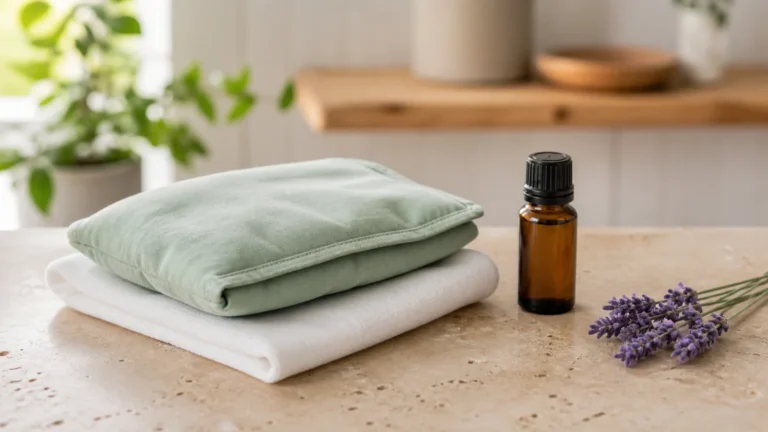
- Wrap a cold pack or ice in a thin towel. Apply it for about 15 to 20 minutes at a time. Remove it sooner if the skin becomes painfully cold, numb, pale, or blotchy.
- Elevate the area above heart level when this is comfortable and practical.
- Use gentle compression only when appropriate. A bandage should not cause tingling, numbness, increased pain, or color change beyond the bruise.
- Monitor the injury. A simple bruise should gradually become less painful and swollen, even though discoloration may take longer to fade.
Do not place ice directly on skin. Do not puncture a bruise, try to drain a hematoma, or keep exercising through significant pain. If you need pain medicine, ask a clinician or pharmacist what is appropriate for you—especially if you take an anticoagulant, have kidney or liver disease, have a bleeding disorder, or use other medicines.
Do essential oils make bruises heal faster?
There is no strong clinical evidence that an essential oil reliably shortens the healing time of ordinary bruises. Much of the online advice comes from traditional use, testimonials, laboratory experiments, or research on products that contain several active ingredients.
Those forms of evidence cannot tell us whether the essential oil itself caused an improvement. Bruises naturally change color and fade, so before-and-after stories are particularly easy to misinterpret. A useful study would compare a clearly defined oil preparation against an appropriate control, use blinded assessment, and report both benefit and skin reactions. That evidence is not currently available for common aromatherapy bruise blends.
Helichrysum: a reputation ahead of the evidence
Helichrysum essential oil is the oil most often promoted for bruises. A 2021 review found a severe shortage of strong clinical studies for Helichrysum italicum. It describes an uncontrolled observation involving a multi-step oral and topical protocol after surgery, but that does not establish that topical helichrysum essential oil treats a typical bruise.
The review also covers extracts, whole-plant preparations, mixed formulas, and isolated constituents. These are not interchangeable with the distilled essential oil. Laboratory or wound-healing findings cannot be converted into a proven bruise recipe.
Lavender, cypress, geranium, and other oils
Lavender may provide a pleasant aroma, but there is no good evidence that it clears trapped blood under the skin. Claims that cypress “constricts vessels” or that geranium, lemongrass, peppermint, or rosemary “improves circulation” enough to heal a bruise are not established clinical treatment recommendations.
This matters because repeatedly applying concentrated oils can add irritant or allergic dermatitis to an already tender area. A burning sensation is not evidence that an oil is repairing tissue.
An optional low-dilution skin oil
This is a fragrance-oriented option, not a treatment. Use it only for a small bruise from a minor injury, after serious injury has been ruled out, and only when the skin is fully intact.
For one fluid ounce (30 mL) of an unscented carrier oil:
- 3 drops lavender essential oil
- 3 drops helichrysum essential oil
This makes an approximately 1% dilution. Mix in a clean, labeled bottle. Patch test away from the bruise first. If tolerated, smooth a very small amount lightly over intact skin once; do not press deeply or massage aggressively. Stop for burning, redness, itching, rash, headache, nausea, or worsening pain.
There is no need to reapply every few hours. More oil does not mean faster healing. If cost, fragrance sensitivity, medication questions, or skin reactivity are concerns, skip the blend—the bruise does not need essential oil to recover. Review our broader essential-oil safe-use guidance before any topical use.
When not to put essential oils on a bruise
Avoid topical essential oils:
- on broken, scraped, blistered, infected, or recently sutured skin
- around the eyes or on a black eye
- on a new injury with severe pain, rapid swelling, deformity, numbness, weakness, or reduced movement
- on a suspected fracture, blood clot, compartment syndrome, or large hematoma
- after surgery or an injection unless the treating clinician approves the product and timing
- under a tight wrap, heating pad, or hot compress
- on a child’s unexplained bruise
- when a clinician needs to see the unaltered skin finding
Do not swallow essential oils to treat bruising. Do not use them to “thin” or “move” blood. Never puncture the skin to apply oil underneath it.
Avoid wintergreen and birch DIY blends
Wintergreen oil is rich in methyl salicylate, a chemical related to aspirin. Poison Control warns that swallowing wintergreen oil can be equivalent to swallowing many adult aspirin tablets. Concentrated topical exposure can also be hazardous, particularly when used over a large area, under heat or occlusion, in children, or alongside medicines that affect bleeding.
Birch oil may also contain high levels of methyl salicylate. These oils are poor choices for homemade bruise blends. Keep all essential-oil bottles locked away from children. If someone swallows an essential oil or has a concerning exposure, contact Poison Control in the United States at 1-800-222-1222 or use your local poison service.
Bruising and blood-thinning medicines
Anticoagulants and antiplatelet medicines can make bruising more likely or allow bleeding to continue longer. Examples include warfarin, apixaban, rivaroxaban, dabigatran, heparin, aspirin, and clopidogrel. Some anti-inflammatory pain medicines, corticosteroids, antibiotics, antidepressants, and supplements can also contribute to bruising in some situations.
Do not stop a prescribed medicine because of a bruise. These medicines often prevent strokes, heart attacks, or dangerous blood clots. Contact the prescribing clinician or anticoagulation service about new, severe, unexplained, or increasing bruising and follow the medication-specific advice you were given.
Ask a pharmacist before adding essential oils, herbs, supplements, or nonprescription pain medicines. Interaction data for essential oils are incomplete, and “natural” does not mean interaction-free.
When unexplained bruising needs evaluation
Make a medical appointment if you:
- suddenly start bruising or bruise much more easily than before
- frequently develop large or painful bruises
- have bruises on the chest, abdomen, back, or face without a clear cause
- also have nosebleeds, bleeding gums, blood in urine or stool, unusually heavy periods, or prolonged bleeding from small cuts
- notice a firm lump over a bruise
- have a personal or family history of unusual bleeding
- developed bruising after starting a medicine or supplement
- have fatigue, fever, recurrent infections, weight loss, or feel generally unwell
A clinician may review injuries, medicines, supplements, family history, and other symptoms and decide whether blood counts or clotting tests are needed. Do not start a “capillary strengthening” supplement or cleanse before the cause is understood.
Seek urgent care after a significant injury
Get urgent evaluation for a bruise with very painful or rapidly increasing swelling, marked pressure or tightness, numbness, weakness, pale or cool skin beyond the injury, inability to bear weight, a visible deformity, or inability to move the affected area normally.
Extreme pressure inside an injured limb can signal compartment syndrome, an emergency in which rising tissue pressure reduces blood flow. A large hematoma can also conceal more significant bleeding or injury. Do not massage these areas or wait for an essential oil to work.
Call emergency services for uncontrolled bleeding, fainting, confusion, difficulty breathing, signs of shock, or a major accident.
Bruising after a head injury
A visible bruise does not show whether the brain is safe. Seek emergency care after a head injury for worsening headache, repeated vomiting, increasing drowsiness, confusion, slurred speech, weakness, seizure, unequal pupils, loss of consciousness, or unusual behavior.
Get individualized advice after a head impact if the person takes an anticoagulant or has a bleeding disorder, even when the outside bruise looks small. Do not apply essential oils near the eyes, nose, mouth, or injured scalp in an attempt to assess or treat a possible concussion.
Bruises in babies and children
Children often bruise during ordinary play, especially over bony areas such as shins and knees. However, unexplained bruises, large bruises after a minor bump, bruising in a baby who is not yet mobile, or marks in unusual locations deserve pediatric assessment.
Do not use adult essential-oil recipes on children. Do not cover a bruise before a clinician has seen it, and do not let an oil replace evaluation of a possible fracture or head injury.
Bruising can also be a sign of abuse. If a child, older adult, partner, or dependent person may be unsafe, prioritize immediate safety and professional help. In an emergency, call emergency services. A healthcare professional can document injuries and connect the person with confidential support.
Older and fragile skin
Skin becomes thinner with age and loses some of the fatty layer that cushions small blood vessels. Sun exposure and corticosteroid medicines may further increase fragility. This can make bruises on forearms and hands appear after minor contact.
Fragile skin is also more likely to tear. Avoid forceful rubbing, adhesive-heavy coverings, and concentrated essential oils. Protective sleeves, better lighting, clear walking paths, and review of fall risks and medicines may be more useful than a topical blend. New or changing bruising should still be discussed with a clinician rather than attributed to age automatically.
What not to do
- Do not use neat helichrysum, peppermint, cypress, lemongrass, geranium, wintergreen, or birch oil.
- Do not use vigorous massage on a fresh bruise or hematoma.
- Do not alternate intense heat and cold in an attempt to “move blood.”
- Do not drain a bruise with a needle.
- Do not apply oils to broken skin, a surgical incision, or around the eye.
- Do not stop an anticoagulant or other medicine without medical guidance.
- Do not assume every purple mark is a harmless bruise.
The essential-oil first aid kit guide offers a broader framework for keeping aromatherapy separate from actual emergency care.
The bottom line
For a small bruise after a minor bump, use rest, elevation, and a wrapped cold pack, then allow the body time to reabsorb the blood. Essential oils—including helichrysum—have not been proven to speed that process.
An adult who enjoys the aroma may choose a one-percent lavender and helichrysum skin oil after confirming that the injury is minor and the skin is intact. Keep expectations modest and stop if the skin reacts. Unexplained, severe, expanding, recurrent, or medication-associated bruising belongs with a healthcare professional, not a stronger DIY blend.
Sources
- Bruise: First aid, Mayo Clinic, April 17, 2024.
- Easy bruising: Why does it happen?, Mayo Clinic, May 30, 2025.
- Bruise, MedlinePlus Medical Encyclopedia, reviewed November 6, 2024.
- Bleeding into the skin, MedlinePlus Medical Encyclopedia, reviewed November 6, 2024.
- Symptoms of mild traumatic brain injury and concussion, Centers for Disease Control and Prevention.
- Cut, scrape, or bruise symptom guidance, American Academy of Pediatrics.
- Anticoagulant medicines: side effects, NHS.
- A Review and Evaluation of the Data Supporting Internal Use of Helichrysum italicum, Plants, 2021.
- Aromatherapy, U.S. Food and Drug Administration.
- Essential oils: Poisonous when misused, National Capital Poison Center.
This article is for education only and is not a diagnosis or treatment plan. Seek individualized medical advice for unexplained bruising, significant injury, medication questions, or concerning bleeding.